
Restorative Justice in Global Health
This blog originally appeared in 2024 on “The Collective Blog”: https://www.globe.uio.no/english/research/networks/the-collective-for-the-political-determinants-of-health/blog/felix-stein/restorative-justice-in-global-health.html
An important shift is occurring in global health ethics. A field that used to be intensely concerned with questions of distributive justice increasingly sees calls for restorative justice emerge. This became particularly evident during the early years of the Covid-19 pandemic. Following recent calls for greater attention to global health justice debates, Collective member Felix Stein considers such restorative justice claims in greater detail.
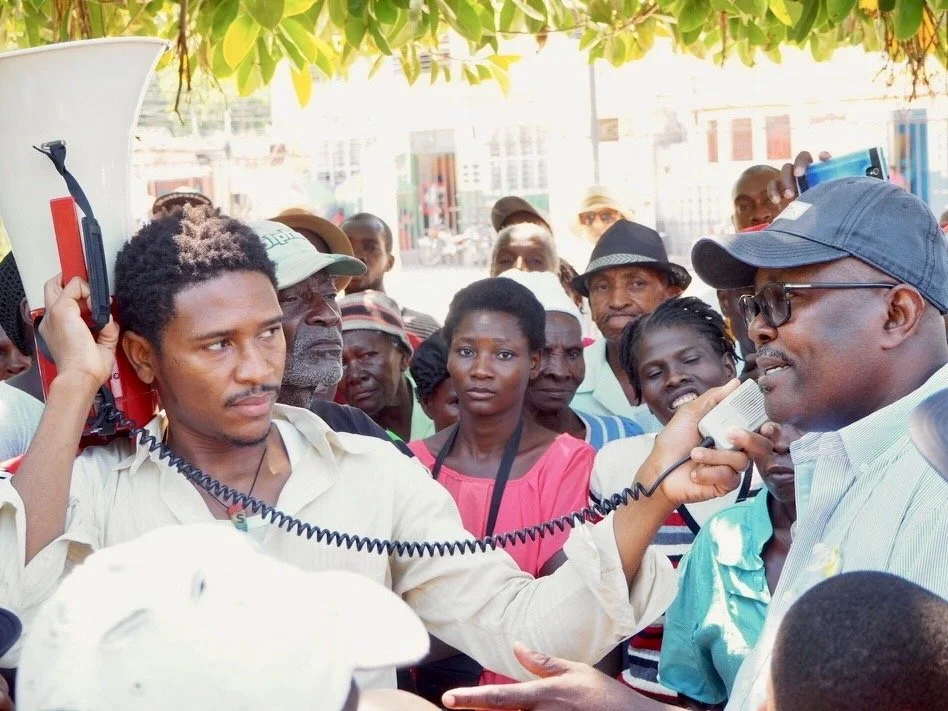
Reparations activist Mario Joseph at a protest for reparations over Cholera in Haiti, 2018. Photo by F. Stein
Distributive justice as starting point
During the early days of the pandemic, leading global vaccination ethicists quickly established that “fairly distributing a Covid-19 vaccine among countries is a problem of distributive justice”. According to them, vaccine distribution should focus first and foremost on limiting harm. This led to debates on whether this would best be achieved by distributing vaccines based on country population size, or whether other factors should be taken into account, such as population mortality, morbidity and access to healthcare or economic and social deprivation.
Distributive justice concernscontinued to dominate policy discussions even as ethical guidelines for vaccine distribution were flagrantly ignored by the governments of high-income countries and corporate executive boards. Global vaccine distribution descended into a familiar tug of war between oligopolistic vaccine producers and the world’s most affluent governments. Observers rightly pointed out that vaccine hoarding by high-income countries cost millions of lives, that intellectual property (IP) protection stood in the way of health equity, that vaccine donations from the world’s richest to the poorest countries in pandemic times were insufficient, and that no excess-profit taxes were used to redistribute pandemic-related corporate rents.
Yet, a new set of arguments also gained traction during the pandemic. As the persistence of stark health inequalities became evident to an ever-larger group of people, global health scholars and activists focused increasingly on restorative justice.
Restorative justice and Covid-19
Restorative justice claims arose, for example, in the United States (US), where Covid-19 incidence and mortality differed significantly, depending on people’s ethnic background. Between February 2020 and May 2023, Black, Hispanic, Native American and Pacific Islander groups had much higher age-adjusted Covid-19 mortality rates than White and Asian Americans. Native Americans suffered the greatest losses while Asian Americans suffered the least. Given that health disparities between ethnic groups largely reflect the US’ history of conquest, dispossession, slavery and racism, it was suggested that the health response should be part of wider racial-justice agendas. Concretely, after the first wave of Covid-19 hit Black Americans the hardest, scholars and health practitioners proposed that an appropriate pandemic response include reparations to Black Americans and account for ethnic belonging in disease transmission models, and in prevention and control measures.
On a global level, restorative justice was also frequently invoked, particularly with reference to vaccine access. One year into the Covid-19 pandemic, global vaccine inequality between wealthy and poorer countries had become so stark as to amount to “vaccine Apartheid” largely resulting from racialized global capitalism. As long ascapitalism’s structural foundations, including trade regulations, IP law, contract secrecy and limits to technology transfers were unchanged, vaccine donations and aid payments in pandemic times were seen to perpetuate - rather than break with - colonial hierarchies. An exclusive focus on aid and charity risked sustaining global divisions between those whose lives are treated as valuable, from those who lack “biolegitimacy”, i.e. people whose lives are treated as if they were disposable (Fassin 2020: 162).
However, restorative justice claims have not just followed ethnic and ethno-nationalist lines. They have also been directed against states and governments, on the grounds of failing to protect citizens. For example, the US-based Hastings Centre has called for an American Covid-19 commission, as over half a million Americans died from the pandemic in less than a year. The US lost more people from Covid-19 than in any war in recent history. From December 2020 it counted more deaths per day than during the 9/11 terrorist attacks. Given that a large proportion of these deaths could have been averted, the Centre calls for compensation to the American victims of preventable Covid-19. Specifically, it asks for reparations to cover the medical expenses of Long Covid victims and for reparations to minors who have lost parents or guardians to the disease.
More diffuse restorative justice claims are also on the rise. A member of the Inter-American Court of Human Rights has floated the idea of an international Truth and Reconciliation Commission for the Covid-19 pandemic, not least to assess the legality of lockdowns and free movement restrictions as well as the ways in which they were enforced by the police and military. Intergenerational compensation claims have also been suggested in the context of lockdowns, which can be seen as having shifted the burden of Covid-19 from the elderly to the young. Lastly, frontline and essential workers call for restorative justice over extraordinary exposure to pandemic harm. In the UK, for example, the doctors’ group ‘Long Covid Doctors for Action’ is launching a class action lawsuit for the compensation of health professionals after contracting Long Covid at work.
What to make of restorative justice in global health?
One may look at the rise of restorative justice claims in global health with scepticism. They risk unjustly dividing people into victims and perpetrators, often along ethnic and ethno-national lines. Restorative justice may also be overly past-oriented, thereby making space for narratives of resentment to emerge instead of fostering future-oriented collaboration. It may also accelerate a ‘juridification’ of global health politics, further bureaucratizing political struggles, whilst rendering them dependent on people’s access to functioning legal systems. Such common critiques of restorative justice claims are valid at times and overblown at others (see Banner 2023: chapter 4). I will here not analyse them in detail but highlight two aspects of restorative justice claims in global health that show that they should not be dismissed out of hand.
Firstly, while restorative justice claims are always concerned with past harm, they can also have a transformative, future-oriented outlook. Many contemporary reparations scholars and activists call for them at least in part because they want to change the world we live in today and tomorrow. In those cases, restorative justice can act as a welcome addition - rather than a divisive alternative - to distributive justice approaches. Indeed, much like the best distributive justice scholarship, calls for restorative justice tend to be grounded in a rights-based approach to health. Thereby, they highlight the shortcomings of conceiving of health through the sometimes technocratic and sometimes ethno-nationalist lenses of ‘global health security’ or global health growthism.
Secondly, restorative justice claims are attuned to history, avoiding many of the shortcomings of an overly technocratic presentism that defines so much of global health policy making today. Their diachronic approach to global health policy and practice is often more in tune with people’s lived experience. It also highlights the importance and malleability of human agency. Thus, restorative justice arguments show systematically that many of the seemingly exogenous global health disasters are ultimately home-made. They further stress that perpetrators of harm are capable of atonement and non-repetition, while victims can be capable of forgiveness. In highlighting our social and individual capacity for change, they usefully conceive of global health institutions as works in progress, rather than fully formed centres of top-down expertise.
Conclusion
The fact that restorative justice approaches to global health are still relatively underdeveloped raises the question of when they should or should not be applied. The philosopher Margaret Urban Walker (2006) argued that restorative justice is particularly useful in social settings where “a truly shared moral baseline of reciprocal responsibility and equal dignity” has not yet been established. In such contexts, the term “restoration” does not so much point to the return to a desirable previous situation, but to “repairs that move relationships in the direction of becoming morally adequate”. In that light, a key question for us seems to be whether global health inequalities can even remotely be considered morally acceptable today.
Notes
I would like to thank Tabitha Hrynick for helpful edits and copy-edits.
About the Author
Dr Felix Stein is the Principal Investigator of the Reparations and Global Development Project (REPAIR), at the University of Amsterdam. He has written extensively on global health financing, and he is the founder and publisher of the Open Encyclopedia of Anthropology.