Why Climate Repair must be here and now: Fieldnotes from the Yasawas
Mausumi Moran Chetia shares three stories from the Yasawa Islands in Fiji and reflects on why climate repair must become a tangible reality here.
From the shore, the Yasawa Islands appear ethereal: turquoise waters, music carried by the wind, and lives woven around the sea. Yet when one gets closer and stays longer, it feels like an oasis. Beneath this beauty, the shoreline is quietly disappearing. Sea walls are rising as the ocean advances, dams are drying as water becomes scarce and creeks widen into the land. For iTaukei communities in Fiji’s Yasawas, climate change is a tangible-felt reality. Their homes, relationships, social systems, traditional governance and ways of life are slowly threatened by erosion. If climate repair is to mean anything, it must begin here and it must begin now.
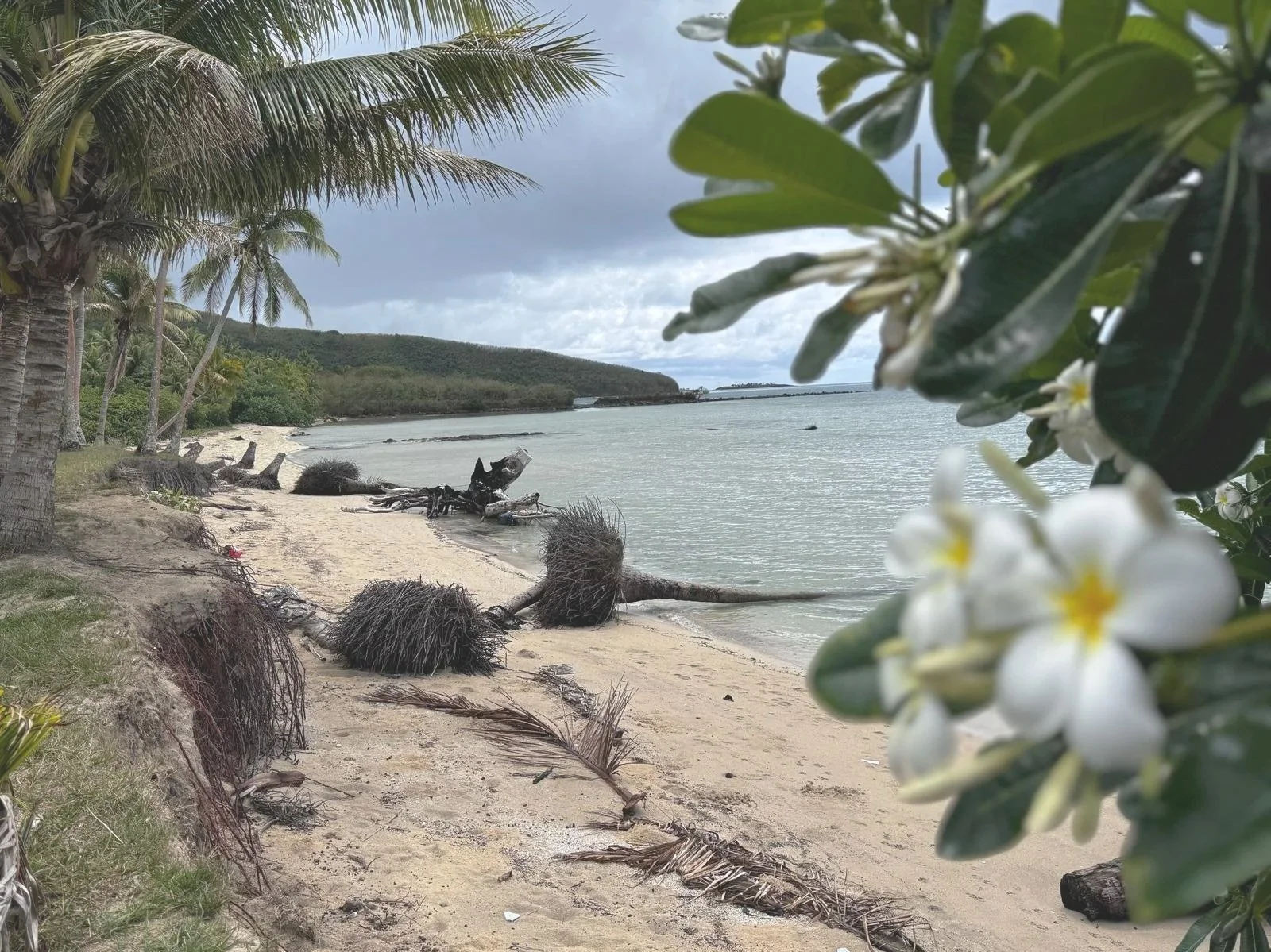
The shore of the visit being violently eroded, before the sea wall was constructed in 2026. In the background are the Firangi Pani flowers characterstic of the Yasawas. Photograph by author . November 2025
Introduction
Life looks exquisite surrounded by turquoise green and indigo blue waters from the shore here in Fiji’s Yasawa islands. The islands are by far, one of Fiji’s most popular holiday locations or so I am informed by my interlocutors. Not just (mostly male) colleagues back in the Netherlands but even colleagues in mainland Fiji stated that they were “jealous” of my fieldwork. That, I am “lucky” to work in such an “exotic, holiday” location. I was dumbstruck by the expression, especially coming from critical social scientists, and aid workers from multilateral organisations, who I suppose, are well aware of the othering capacity of the term “exotic”.
Giving the colleagues the benefit of doubt, I suppose their reference here is to the pristine waters of the Pacific where life is so “tranquil and calm” as well as fieldwork in a touristed destination such as Fiji. And to be fair, indeed the Yasawas are wonderful in many ways. Daily life in the two villages I am working with is joyous and filled with laughter, and music is everywhere including indigenous and church music. Then there is also the constant music of the winds accompanied by the interlude of the waves and the fragrance of the sea.
Yet, the spectacular beauty owing to its location in the Pacific Ocean, is exactly what can make life on the Yasawa islands eerily challenging at times, especially during the nights. The mainland is on a remote location, its shores nowhere to be seen from where the villages. This distance makes the residents even forgiving to their elected representatives for being ‘unable’ to provide fundamental necessities such as running water and electricity even as of 2026. “How will they come, we are so far away!” argue my interlocutors. Darkness is, however, not silent here. The sounds of roosters, the wind, the dogs and occasional cats, the waves and the dimming solar lamps in a few houses are its constant companions. The melodies of musical prayers are carried by the wind.
On one such evening, I was sitting idly wondering which house to visit to charge my electronic gadgets as everyone does not have sockets and solar panels here. The house of my host family is made of concrete and stands directly on the ground – a rare sight in the village where most houses are made of wood and stand on stilts. The neighbour’s house, which I can see through the fluttering curtain of my window, is a case in point. It is a stilted wooden house accommodating six family members. Stilted for letting the annual floodwaters from the rains pass through in peace, that show up during the summer months of November until April. Today, I want to share with you three water stories from my ongoing research in two villages in Naviti island, part of the Yasawa group of islands in West Fiji. These stories reiterate the reasons as to why repair must be here and now in this part of the world.
Three Stories
Story one: The sea wall
As our fiber glass boat arrived near the village on the first day of my stay, our boat’s captain who is also my host exclaimed, “you will see a few things changed this time (compared to our previous year’s stay)”. His smile grew wider as we drew closer. I realized his “change” referred to the much-coveted sea wall, a promise of nearly a decade by a government department along with a non-governmental organization to the people of this village witnessing extreme erosion of the shores from the last few decades. The wall is a form of “nature-based solution” as informed to me by an engineer of the Waterways department involved with the wall’s construction – to last for “twenty to thirty years”. To my non-expert eye, it appears to be a pile of stones stacked on top of one another along the shore; while filling the roots of the coconut trees with soil that were uprooted and near-fallen the last time we’d seen them. They were supported to stand, slanted rather than straight, but stand nonetheless by the soil that was a part of the sea wall. The beach felt a bit away from the border of the village too.
Strong winds bring in the high tidal waves onto the seawall. Video by author. July 2026
Except for the first three days, most of my stay here has been marked by a heavy and constantly blowing wind for over a week. The interlocutors do not complain, saying this is normal for the seasons, although most of them are unable to go fishing as it is “very rough out there.” Given that mobile connectivity is also quite challenging here, I have developed a habit of searching a place every day to get network and call my family from. On most days, it happens to be a particular patch of the beach. So, my morning ritual has been to wake up and make calls home since my arrival. This exercise has also made me witness the “roughness out there” first hand.
Two mornings ago, the high tidal waves had almost covered the entire shoreline. One morning ago, the winds pushed the waves to touch the ground-levels stones of the sea wall. This morning, they seemed to grow up fast, touching the mid-level of the short sea wall. The waves continued to splash onto my hands holding my phone. The ocean remained a ceaselessly spectacular turquoise green and blue of multiple shades.
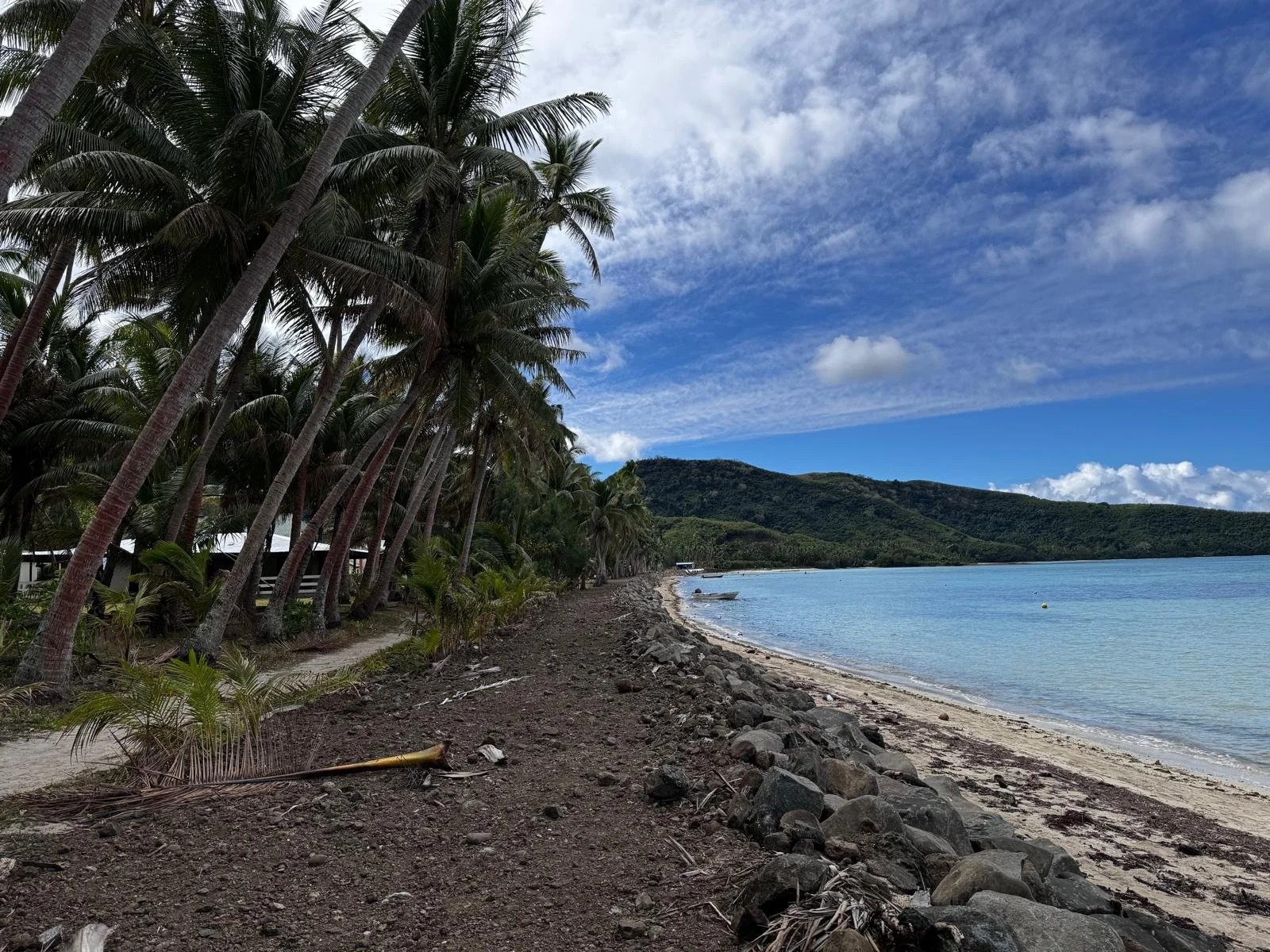
The partially complete sea wall. Photograph by author. July 2026
Story two: The drying dam
The village is surrounded by the ethereal waters of the Pacific Ocean to its east while its western side is adorned by the Vaturua (meaning the two rocks or hills) hill range. Water – that gives life to humans for drinking and daily life requirements - is becoming a scarce entity here, despite efforts by the national, provincial government and many non-government organizations. Some of the interlocutors inform that this year has been a particularly cold winter in the Yasawa islands, with minimal rains and therefore, a deep scarcity of water has come by. In this dry winter season, the village depends on two forms of water sources: first, on rainwater as drinking water – collected through roof harvesting and storing in community tanks between a few families installed by foreign and local aid organisations; and, second, on rainwater keeping a pond on the top of the Vaturuwa mountain that functions as a dam, supplying water for washing, agriculture and other uses.
Although dry winters are expected to bring lesser rainfall leading to water shortages, the Fiji Meteorological Services reported that Yasawa-I-rara has received above average raifall in June 2026 while it was expected to receive “suppressed” or “below normal rainfall” (2:48 – 2:54minutes, FMS, Official Facebook page) from July until September this year. This is likely caused by a strong El Niño event that is underway and strengthening across the tropical Pacific Ocean. El Niño periods in Fiji are traditionally linked to below-normal rainfall and an increased risk of dry spells or drought during the dry season.
The obvious result of the water shortage in both water sources in the village is the lack of drinking water and very economic use of water for cleaning and washing, leading to a lack of hygiene for the residents of the village; and numerous skin diseases for children that continue throughout all the seasons.
Story three: The Widening Creeks
The Pacific Ocean, as I am coming to learn of it, is not a shy or a timid one. It enters the lives of the residents here, metaphorically and literally – freely and unabashedly. I share this through the story of two ever-widening creeks in the villages. A few nights ago, I was visiting one of the villages that had hosted me the previous year. A teacher from the local school had kindly offered to accompany me on the walk of about just twenty minutes. By the time our evening tea sessions were complete, it was about 6:30pm. This village was better equipped with solar lamps that function throughout the night. So, the night didn’t feel as dark here. With a lunch invitation for the following Sunday in hand, we bid our sota taale (see you again in Yasawan dialect) and resumed our return journey. Then what began felt like a forever journey.
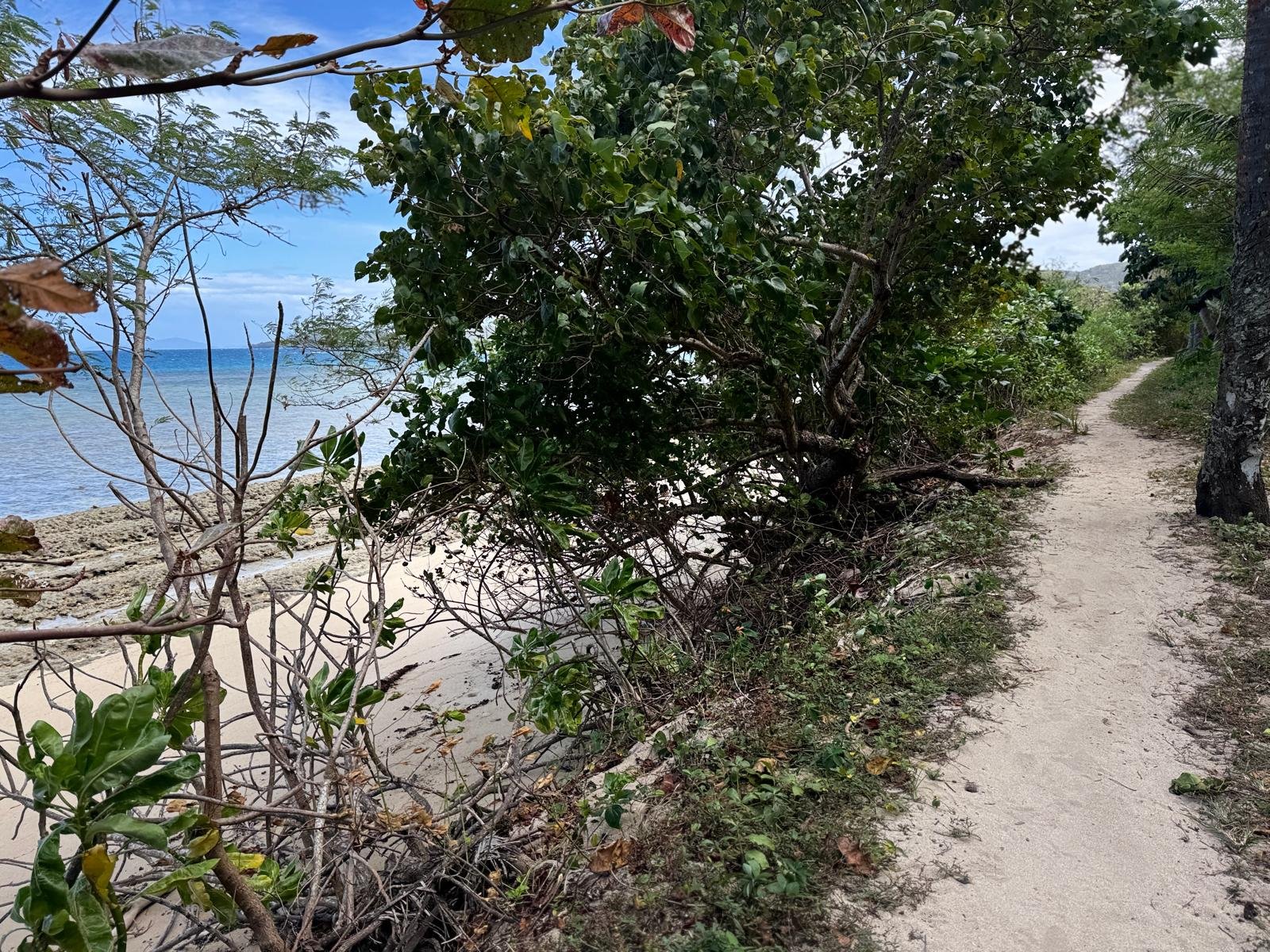
The pathway along the shore between the two villages. Photograph by author. July 2026
The schoolteacher, my co-traveler, is a mainlander from the Ba province who has lived in the island for almost a decade. She seemed like a seasoned traveler of the Yasawa night. The twenty-minute walk along the shore is marked by three graveyards, a thick patch of wild growth of plants and an array of abandoned houses whose owners have either passed away or left the concrete houses after they showed cracks through the walls due to the sandy land. It was also filled with two creeks at the start and end of the journey – water piercing through and into the land from the ocean.
One of the creeks was formed in a short time during our visit, thanks to the high tides, and took my co-traveler by surprise. She, being the kind host that people here are, offered to see the depth of the creek first and the safety for me to cross it. Albeit with challenge of carrying the torches and bags in our hands, we crossed the creek with nearly knee-deep water. The thick patch gave way to a rocky patch where the waves were adamantly determined to kiss our feet. Nearing the village, we realized that the tiny creek we’d seen while leaving our village turned into a wide one if not a deep creek.
The wide creek, the forthcoming ocean, the sounds of the waves and the dark night welcomed us back into the village.
Conclusion
The joys of traditional Fijian ways of living, music, laughter, and the sheer beauty of the pristine waters are what define the Yasawas. Yet, what remains embossed of this experience within the outsider-researcher like me is the slow yet constant erosion of the shoreline of the two villages. That and the possible eroding away of a way of life for the iTaukei (indigenous) coastal people of this village - who do not want to be moved away from here or relocated to the mainland, despite the many precarities of life.
23rd July 2026 marked the first anniversary of the International Court of Justice’s landmark Advisory Opinion on Climate Responsibilities of the state. All residents in the Yasawa islands, like the village I am currently in, may not be accustomed to the call for and multiple ways of claiming legal reparations for climate change. They, however, are bearing every brunt and all forms of climate harms – scanty and erratic rainfall and extreme seasons, an eroding shoreline and a rising and incoming ocean – for which repair is a must. How to reach this repair, in the legal form i.e. who is responsible for the anthropogenic climate actions leading to slow catastrophes and their intergenerational effects, and how they must be held accountable have already been shown to the world one year ago by the ICJ – so why the delay in climate actions and climate reparations?
Mece music rehearsal in the village. Video by author. 2026
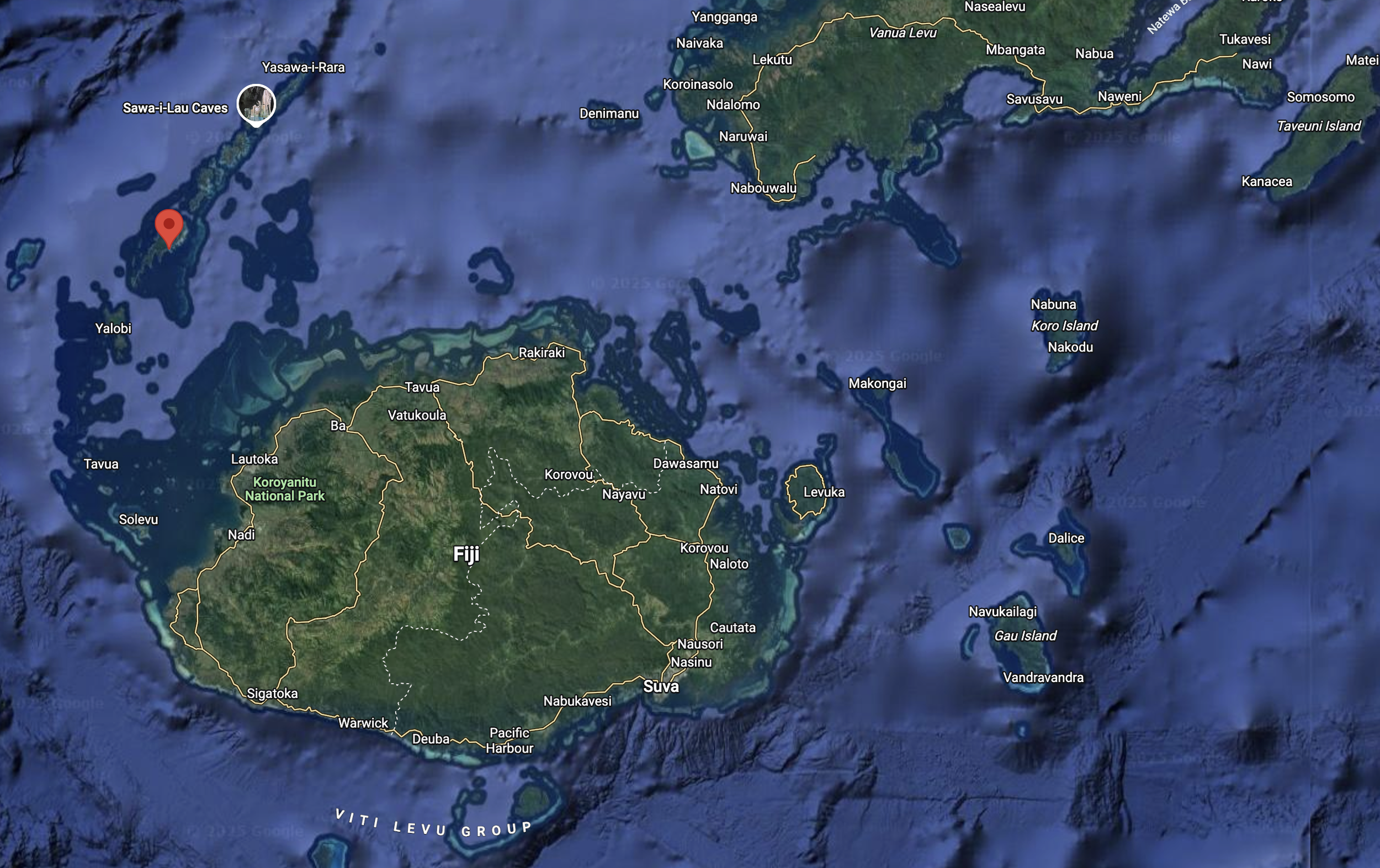
Naviti Island of the Yasawa Group of Islands. West Fiji.
Acknowledgements
Thank you to the interlocutors and residents of Marou and Malevu villages for sharing their lives and stories with me, and permitting me to share them with the “people in my world”. I would like to thank Felix Stein for helpful edits. A special thank you to Mayank for pushing me to write this down in the traditional form – with a pen on paper, and input.
About the Author
Dr. Mausumi Moran Chetia is the postdoctoral researcher of the project Reparations and Global Development Project (REPAIR). She writes on climate-related disasters, (im)mobilities and displacements.
Restorative Justice in Global Health
This blog originally appeared in 2024 on “The Collective Blog”: https://www.globe.uio.no/english/research/networks/the-collective-for-the-political-determinants-of-health/blog/felix-stein/restorative-justice-in-global-health.html
An important shift is occurring in global health ethics. A field that used to be intensely concerned with questions of distributive justice increasingly sees calls for restorative justice emerge. This became particularly evident during the early years of the Covid-19 pandemic. Following recent calls for greater attention to global health justice debates, Collective member Felix Stein considers such restorative justice claims in greater detail.
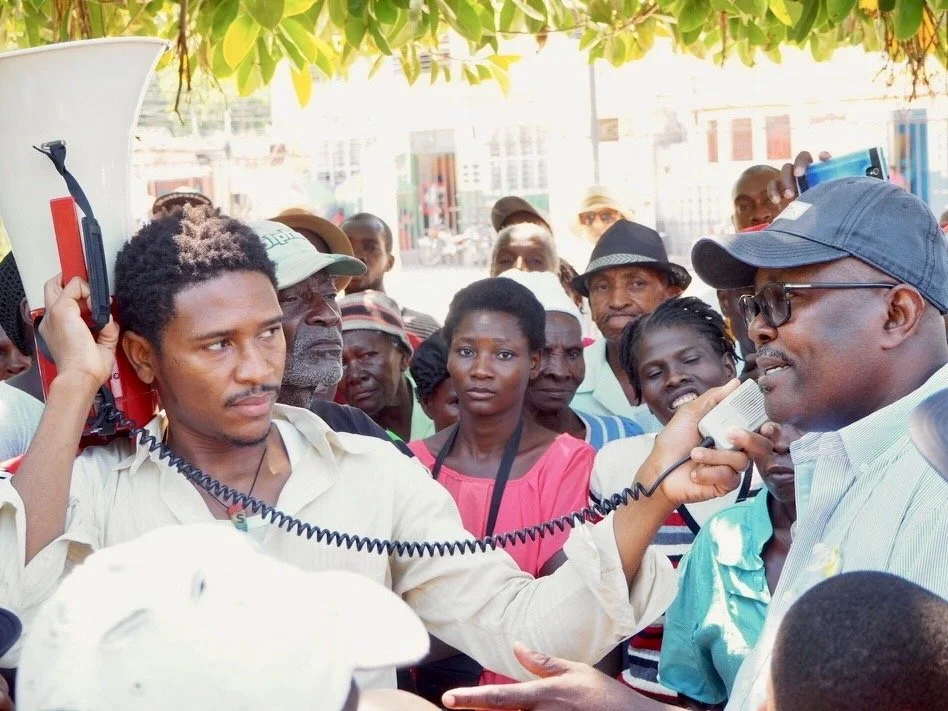
Reparations activist Mario Joseph at a protest for reparations over Cholera in Haiti, 2018. Photo by F. Stein
Distributive justice as starting point
During the early days of the pandemic, leading global vaccination ethicists quickly established that “fairly distributing a Covid-19 vaccine among countries is a problem of distributive justice”. According to them, vaccine distribution should focus first and foremost on limiting harm. This led to debates on whether this would best be achieved by distributing vaccines based on country population size, or whether other factors should be taken into account, such as population mortality, morbidity and access to healthcare or economic and social deprivation.
Distributive justice concernscontinued to dominate policy discussions even as ethical guidelines for vaccine distribution were flagrantly ignored by the governments of high-income countries and corporate executive boards. Global vaccine distribution descended into a familiar tug of war between oligopolistic vaccine producers and the world’s most affluent governments. Observers rightly pointed out that vaccine hoarding by high-income countries cost millions of lives, that intellectual property (IP) protection stood in the way of health equity, that vaccine donations from the world’s richest to the poorest countries in pandemic times were insufficient, and that no excess-profit taxes were used to redistribute pandemic-related corporate rents.
Yet, a new set of arguments also gained traction during the pandemic. As the persistence of stark health inequalities became evident to an ever-larger group of people, global health scholars and activists focused increasingly on restorative justice.
Restorative justice and Covid-19
Restorative justice claims arose, for example, in the United States (US), where Covid-19 incidence and mortality differed significantly, depending on people’s ethnic background. Between February 2020 and May 2023, Black, Hispanic, Native American and Pacific Islander groups had much higher age-adjusted Covid-19 mortality rates than White and Asian Americans. Native Americans suffered the greatest losses while Asian Americans suffered the least. Given that health disparities between ethnic groups largely reflect the US’ history of conquest, dispossession, slavery and racism, it was suggested that the health response should be part of wider racial-justice agendas. Concretely, after the first wave of Covid-19 hit Black Americans the hardest, scholars and health practitioners proposed that an appropriate pandemic response include reparations to Black Americans and account for ethnic belonging in disease transmission models, and in prevention and control measures.
On a global level, restorative justice was also frequently invoked, particularly with reference to vaccine access. One year into the Covid-19 pandemic, global vaccine inequality between wealthy and poorer countries had become so stark as to amount to “vaccine Apartheid” largely resulting from racialized global capitalism. As long ascapitalism’s structural foundations, including trade regulations, IP law, contract secrecy and limits to technology transfers were unchanged, vaccine donations and aid payments in pandemic times were seen to perpetuate - rather than break with - colonial hierarchies. An exclusive focus on aid and charity risked sustaining global divisions between those whose lives are treated as valuable, from those who lack “biolegitimacy”, i.e. people whose lives are treated as if they were disposable (Fassin 2020: 162).
However, restorative justice claims have not just followed ethnic and ethno-nationalist lines. They have also been directed against states and governments, on the grounds of failing to protect citizens. For example, the US-based Hastings Centre has called for an American Covid-19 commission, as over half a million Americans died from the pandemic in less than a year. The US lost more people from Covid-19 than in any war in recent history. From December 2020 it counted more deaths per day than during the 9/11 terrorist attacks. Given that a large proportion of these deaths could have been averted, the Centre calls for compensation to the American victims of preventable Covid-19. Specifically, it asks for reparations to cover the medical expenses of Long Covid victims and for reparations to minors who have lost parents or guardians to the disease.
More diffuse restorative justice claims are also on the rise. A member of the Inter-American Court of Human Rights has floated the idea of an international Truth and Reconciliation Commission for the Covid-19 pandemic, not least to assess the legality of lockdowns and free movement restrictions as well as the ways in which they were enforced by the police and military. Intergenerational compensation claims have also been suggested in the context of lockdowns, which can be seen as having shifted the burden of Covid-19 from the elderly to the young. Lastly, frontline and essential workers call for restorative justice over extraordinary exposure to pandemic harm. In the UK, for example, the doctors’ group ‘Long Covid Doctors for Action’ is launching a class action lawsuit for the compensation of health professionals after contracting Long Covid at work.
What to make of restorative justice in global health?
One may look at the rise of restorative justice claims in global health with scepticism. They risk unjustly dividing people into victims and perpetrators, often along ethnic and ethno-national lines. Restorative justice may also be overly past-oriented, thereby making space for narratives of resentment to emerge instead of fostering future-oriented collaboration. It may also accelerate a ‘juridification’ of global health politics, further bureaucratizing political struggles, whilst rendering them dependent on people’s access to functioning legal systems. Such common critiques of restorative justice claims are valid at times and overblown at others (see Banner 2023: chapter 4). I will here not analyse them in detail but highlight two aspects of restorative justice claims in global health that show that they should not be dismissed out of hand.
Firstly, while restorative justice claims are always concerned with past harm, they can also have a transformative, future-oriented outlook. Many contemporary reparations scholars and activists call for them at least in part because they want to change the world we live in today and tomorrow. In those cases, restorative justice can act as a welcome addition - rather than a divisive alternative - to distributive justice approaches. Indeed, much like the best distributive justice scholarship, calls for restorative justice tend to be grounded in a rights-based approach to health. Thereby, they highlight the shortcomings of conceiving of health through the sometimes technocratic and sometimes ethno-nationalist lenses of ‘global health security’ or global health growthism.
Secondly, restorative justice claims are attuned to history, avoiding many of the shortcomings of an overly technocratic presentism that defines so much of global health policy making today. Their diachronic approach to global health policy and practice is often more in tune with people’s lived experience. It also highlights the importance and malleability of human agency. Thus, restorative justice arguments show systematically that many of the seemingly exogenous global health disasters are ultimately home-made. They further stress that perpetrators of harm are capable of atonement and non-repetition, while victims can be capable of forgiveness. In highlighting our social and individual capacity for change, they usefully conceive of global health institutions as works in progress, rather than fully formed centres of top-down expertise.
Conclusion
The fact that restorative justice approaches to global health are still relatively underdeveloped raises the question of when they should or should not be applied. The philosopher Margaret Urban Walker (2006) argued that restorative justice is particularly useful in social settings where “a truly shared moral baseline of reciprocal responsibility and equal dignity” has not yet been established. In such contexts, the term “restoration” does not so much point to the return to a desirable previous situation, but to “repairs that move relationships in the direction of becoming morally adequate”. In that light, a key question for us seems to be whether global health inequalities can even remotely be considered morally acceptable today.
Notes
I would like to thank Tabitha Hrynick for helpful edits and copy-edits.
About the Author
Dr Felix Stein is the Principal Investigator of the Reparations and Global Development Project (REPAIR), at the University of Amsterdam. He has written extensively on global health financing, and he is the founder and publisher of the Open Encyclopedia of Anthropology.

From the Screen to the Heart: Art, Storytelling, and the Demand for Nuclear Justice
Tabitha Hrynick reflects on reparations for nuclear harm in New Mexico.
Reflections on the role of art and storytelling in environmental justice, spurred by watching the updated cut of Lois Lipman’s First We Bombed New Mexico
The cool air, soft seat, and gentle glow in the theatre contrasted with the searing heat, hard dirt, and beige and blue brightness of the desert scene unfolding onscreen. Despite these creature comforts, a special screening of a fresh cut of Lois Lipman’s documentary, First We Bombed New Mexico, transported me back to the event that sweltering mid-summer day in the remote Jornada Del Muerto several months prior.
A group of activists, community members, researchers, journalists, political leaders, and other allies had gathered to mark the 80th anniversary of the Trinity Test – the first nuclear bomb ever detonated on earth – and to dedicate a new sign acknowledging the existence and decades-long fight for justice of New Mexico’s Trinity Downwinders. These unwitting, and now multi-generational victims of radioactive fallout from the blast have suffered serious health, cultural, and economic consequences that continue to this day.
The film crew had joined us to document the event, the footage of which would transform the film from what was previously a story of hard-fought for yet undelivered justice, into one with a much more triumphant ending. In addition to the recognition brought by the sign dedicated near the Trinity site that day, the new cut also updated audiences on a major policy win in the form of monetary compensation for which the Trinity Downwinders have been fighting for decades. The Radiation Exposure Compensation Act (RECA), from which New Mexico Downwinders had been excluded since 1990, would now entitle individuals to $100,000 reparation payments. While modest in comparison to the scale of harm they have endured, this feels like an important step towards healing.
The film’s powerful storytelling, which follows the story of Downwinder and grassroots activist Tina Cordova, alongside other New Mexico Downwinders, elicited the same emotions I had felt when watching it previously – grief, anger, hope – but this time also joy and optimism that further justice was in reach. The film had created a space for me to connect more deeply with, reaffirm, and strengthen my sense of humanity and solidarity – the very reasons I chose to dedicate my PhD research to issues of nuclear injustice. For many of us committed to understanding and fighting injustice in our world, these deeper motivations can sometimes fall into the background as we juggle day-to-day life. Engaging with powerful stories or other forms of artistic expression can help us reconnect with our sense of purpose and renew our commitments.
“Engaging with powerful stories or other forms of artistic expression can help us reconnect with our sense of purpose and renew our commitments.”
Not only can art represent, but it can play an active role in changing reality. Since the launch of its first version in the summer of 2024, it seems the film has been a powerful tool in the Downwinders’ success securing reparation payments. The film is partly credited for expanding US Representative Teresa Legar Fernández’ knowledge of the plight of Downwinders. She would become a champion for the legislation to expand RECA to New Mexico Downwinders and other nuclear harmed communities in the US. Discussing the legislation with the Guardian last year, she evoked a scene from the film in which a survivor recounts playing with her friends in the radioactive ash, even tasting it, which they thought was “summer snow.” All of her friends would go on to pass away at young ages from various forms of cancer.
It is one thing to read a historical narrative or an accounting of events, and entirely another to be invited into fellow humans’ lives and stories – to feel their pain, their resolve, their joy – to imagine dancing with them in radioactive ash. As a researcher trying to contribute to more just public policy and ways of doing for nearly a decade, I know from experience that even the most well-crafted report, policy brief or presentation is hardly if at all sufficient to drive change – certainly not alone. While there is undoubtedly still a role to play for these conventional forms of academic knowledge outputs, it is the level of the human heart and spirit which draws us back to our shared humanity, and to the innate sense of solidarity and justice I believe we all possess. And it is from here that action and change often come.
Unfortunately, as a ‘cradle-to-grave’ nuclear colony, New Mexico is home to many communities contending with nuclear harm and injustice in almost all its forms. In addition to the Trinity Downwinders, these include communities facing chronic radiation exposure from working or living near abandoned uranium mines, or facilities developing nuclear weapons or storing nuclear waste. Many are Indigenous, people of color, and/or ordinary working or middle class folks. All deserve justice for the past, the ceasing of ongoing harm, and guarantees for safe, sustainable futures.
Fortunately, New Mexico is rich with creatives who are harnessing their crafts to shed light on nuclear injustice and inspire change. For now, a shoutout to some of the filmmakers, visual artists, and other artistic visionaries using the powerful medium of their creativity to represent these important stories and to demand justice in New Mexico and beyond:
Films
A growing number of films have been and are being made about nuclear harm and injustice in New Mexico and the wider region. Here are just three I’ve seen and been inspired by recently:
First We Bombed New Mexico https://www.firstwebombednewmexico.com/
Demon Mineral https://www.demonmineral.com/
Ways of Knowing https://www.waysofknowing.us/
Photography and visual arts
Several photographers have put the lens on nuclear injustice in New Mexico. Here are two who powerfully and artistically capture the scale of environmental impact of uranium mining:
Will Wilson’s beautiful and haunting images of the scars of uranium mining across Navajo Nation
Shayla Blatchford’s Anti-Uranium Mining Project also captures this scale, contextualising her images within research and information
Numerous collections, exhibitions, and curated web-based write-ups have featured the works of many more creatives using their talents to address nuclear injustice. While it's impossible to name every artist in this short space, these curated showcases offer a potent way to experience the collective impact of their voices. Some of their works can be seen on the below webpages:
New Art of Atomic Critique is a write-up by the Bulletin of Atomic Scientists Bulletin which features “a new generation of artists exploring non-literal and multi-layered depictions of nuclear injury and anxiety” including local artists Mallery Quetawki and Joanna Keane Lopez.
Mal Aire was a 2024 exhibition at the South Broadway Cultural Center featuring 19 artists reflecting on “the fallout of ‘bad air,’” including from New Mexico’s nuclear legacy. While not visible online today, the exhibit included work from photographer Sofie Hecht who has worked with Downwinders to represent their experiences in intimate ways.
Trinity: Legacies of Nuclear Testing—A People’s Perspective – this exhibition in Las Cruces showcased the work of 17 artists in a “big, swollen cry of the heart” to shed light on nuclear injustice in New Mexico.
Artists Against the Bomb is series of 200 posters that advocate for universal nuclear disarmament, and which reflect diverse anti-nuke art from historical and contemporary periods.
Poetry
Anointed: a heart-wrenching video-poem about radioactive racism offers powerful, poetic words by Marshall Islander and activist Kathy Jetnil-Kijiner who reminds that nuclear injustice is not limited to New Mexico.